
AI Painting: The Science Behind Style Transfer Technology
Have you ever wondered how your everyday photos can transform into breathtaking artworks? How a simple snapshot can capture the essence of Van Gogh's brushstrokes or the dreamlike quality of a Ghibli animation? AI painting isn't just another digital filter. Instead, it uses advanced neural networks to analyze your photo's content and apply artistic elements, creating something entirely new from your original image.
This technology might sound complex, but the results are incredibly accessible. Tools like AIPainting.io have harnessed this power, allowing anyone to become a digital artist. If you’ve ever wanted to understand the "how" behind this creative revolution, you're in the right place. Ready to see the science behind the art? You can try it now and witness the transformation firsthand.
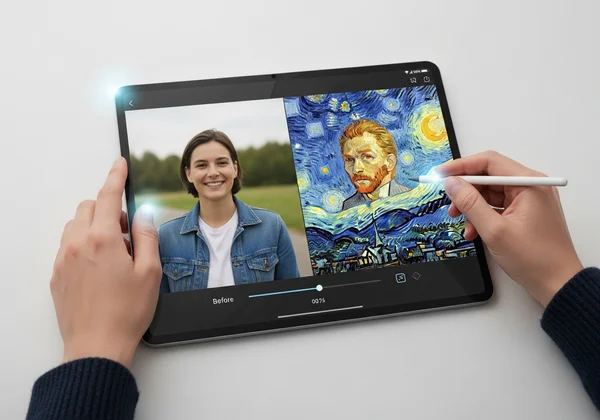
Let's break down how AI painting actually works. We'll explore the neural networks behind the technology and the specific models that transform your photos into stunning artworks. We will uncover the science that powers AI painting and see how it enables you to create unique art effortlessly.
Understanding the Core of AI Painting Technology
AI painting technology has evolved dramatically over the years, transforming how we can turn ordinary photos into extraordinary artworks. It represents a significant leap from basic image editing to a new form of intelligent creation. To appreciate this technology, we need to look beyond the surface and understand the fundamental concepts that make it all possible. This field combines computer vision with artistic interpretation in a truly remarkable way.
The Evolution of Digital Art: From Filters to Neural Networks
In the early days of digital photo editing, "artistic effects" were often simple filters. These filters would apply a uniform overlay or texture to an image. For example, a "sketch" filter might detect edges and darken them, while a "sepia" filter would change the color palette. While fun, these effects lacked true artistic understanding. They couldn't adapt to the content of the photo itself.
The breakthrough came with the rise of neural networks, a type of artificial intelligence modeled after the human brain. Unlike static filters, these networks analyze and understand images. This marks a major shift from simple modifications to true artistic reinterpretation. This shift marked the true beginning of AI painting.
How Neural Networks Learn to "See" Like Artists
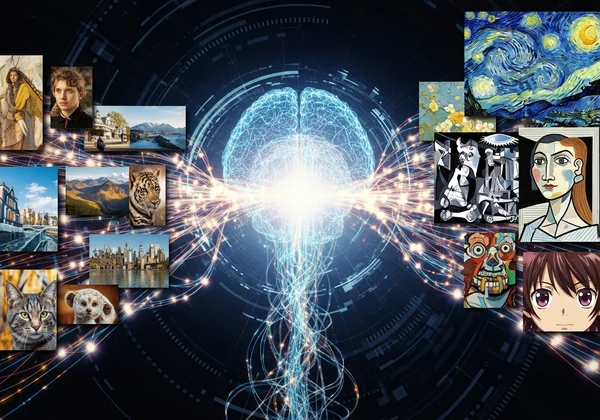
So, how does an AI learn to "see" and "paint"? It all starts with training. A neural network is shown thousands, or even millions, of images. Through this process, it learns to identify objects, textures, patterns, and compositions. This is the "content" part of the equation.
Simultaneously, the network is trained on a vast library of artwork. It analyzes the brushstrokes of Impressionist painters, the color palettes of abstract masters, and the clean lines of Japanese animation. By doing this, it learns to recognize and isolate the unique characteristics of different artistic styles. It learns the "artistic DNA" of a style, allowing it to apply that style to a completely different image.
Decoding Style Transfer Technology
The specific technique that makes AI painting possible is often called neural style transfer. This is the process of taking the content of one image (like your photograph) and combining it with the artistic style of another (like a famous painting). Modern AI art generators have refined this process using advanced models to produce incredible results.
VQGAN-CLIP: The Revolutionary Architecture Behind Modern AI Art
One of the most significant advancements in AI art generation comes from architectures like VQGAN-CLIP. While the name sounds technical, the concept is powerful. VQGAN (Vector Quantized Generative Adversarial Network) is excellent at generating high-quality, detailed images. CLIP (Contrastive Language-Image Pre-training) is a model developed by OpenAI that understands how text descriptions relate to images.
When combined, they create a system that can generate or modify images based on a deep understanding of both visual content and artistic concepts. This powerful duo is part of the engine that allows AI to interpret a style like "Ghibli animation" and apply its core elements—soft lighting, vibrant colors, and whimsical details—to your photo with remarkable accuracy.
The Artistic DNA: How AI Deciphers Visual Styles
When you select a style on an AI painting generator, the AI does more than just copy colors. It performs a deep analysis to identify what makes that style unique. The AI breaks down the "artistic DNA" into several components including:
- Texture: Are the brushstrokes thick and visible, like in an oil painting, or smooth and blended, like in a watercolor?
- Color Palette: Does the style use bold, contrasting colors (like Pop Art) or muted, earthy tones (like Renaissance art)?
- Shapes and Lines: Are the forms sharp and geometric (like Cubism) or soft and flowing (like Art Nouveau)?
- Composition: The AI even learns general compositional rules associated with certain styles.
By understanding these elements, the AI can intelligently translate them onto the structure of your original photograph, creating a new, cohesive work of art.
The Role of Diffusion Models in Photorealistic Style Transfer
More recently, diffusion models have become a leading technology in the AI art space. These models work by starting with random noise and gradually refining it, step-by-step, until it becomes a coherent image that matches a given style and content.
Think of it like a sculptor starting with a block of marble and slowly chipping away until a statue emerges. Diffusion models do this digitally, adding detail and structure with each step. This method is exceptionally good at creating highly detailed and photorealistic results, making it perfect for generating art that feels both imaginative and grounded. It's this cutting-edge approach that produces the high-quality outputs you see from top-tier AI art generators.
The AIPainting.io Technical Ecosystem
Understanding the general technology is one thing, but seeing it in action is another. At AIPainting.io, we've built a technical ecosystem designed to make this powerful technology simple, fast, and accessible to everyone. Our focus is not just on using these advanced models but on curating them to deliver a superior artistic experience.
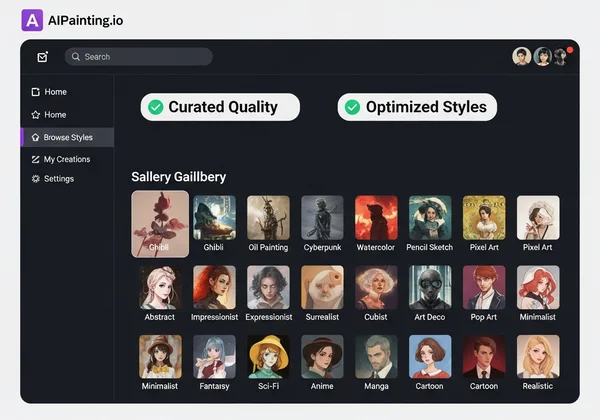
Our Proprietary Style Database: Curated Quality for Artistic Excellence
Not all AI styles are created equal. Instead of offering thousands of mediocre options, we have focused on curating a high-quality style database. Each style in our library, from Ghibli to Oil Painting and Cyberpunk, has been carefully trained and optimized by our team.
This curation process ensures that every transformation produces a visually appealing and authentic result. We fine-tune the models to capture the true essence of each artistic style, avoiding common pitfalls like distorted features or messy artifacts. This dedication to quality is what sets our platform apart, giving you the best possible artistic outcome every time you generate an image.
Real-time Processing: From Upload to Masterpiece in Seconds
The magic of AI art shouldn't be held back by slow processing times. We've optimized our entire technical stack for speed and efficiency. From the moment you upload your photo to when you see the final masterpiece, the process takes just seconds.
This is achieved through a combination of powerful cloud computing resources and highly efficient code. This real-time feedback loop is crucial for creativity. It allows you to experiment with different styles and photos quickly, without breaking your creative flow. The "before and after" slider provides instant visual confirmation, making the creative process both intuitive and exciting.
Balancing Technical Precision with Artistic Expression
The ultimate goal of AI painting is to create art. Although the technology is complex, the final product should feel expressive and human. Our platform is engineered to strike the perfect balance between technical precision and artistic flair.
The AI respects the important details of your original photo—like faces, structures, and key objects—while creatively applying the new style. It doesn't just paint over your image; it reinterprets it. This balance ensures that the final result is not just a technical conversion but a genuinely new piece of art that reflects both your original vision and the chosen style.
Your Journey into AI Art Mastery Starts Here
We've explored the science of AI painting, from the evolution of neural networks to the specific models that power today's generators. You now understand that turning a photo into a painting is not a simple filter but a sophisticated dance between data, algorithms, and artistry. Technologies like style transfer, VQGAN-CLIP, and diffusion models work together to deconstruct and reconstruct images in inspiring new ways.
The best part is that you don't need to be a data scientist to use this incredible technology. Platforms like AIPainting.io have done the hard work for you, creating a tool that is both powerful and incredibly easy to use. The theory is fascinating, but the real magic happens when you see your own photo transformed into a work of art.
Now that you know the science behind the magic, it's time to become the artist. Take your favorite photos—a landscape, a portrait, or even a picture of your pet—and see what you can create.
Ready to start your creative adventure? Visit AIPainting.io and transform your first photo into a masterpiece today!
The Takeaway
What is AI painting and how does it differ from traditional photo filters?
AI painting is a sophisticated process that uses neural networks to analyze the content of your photo and the characteristics of an artistic style, then merges them into a new, unique image. Unlike a traditional filter, which just applies a uniform overlay, AI painting reinterprets your entire image in the chosen style, adapting to shapes, textures, and objects for a much more authentic and dynamic result.
How does AI turn my photos into authentic-looking paintings?
An AI uses a process called neural style transfer. It "learns" the defining features of an artistic style—like brushstroke texture, color palette, and line work—from a vast dataset of artworks. It then applies these stylistic features to the content and structure of your photograph, essentially "repainting" your image as if a master artist from that genre had created it.
What makes AIPainting.io's technology superior to other AI art generators?
AIPainting.io focuses on three key areas: curated quality, speed, and ease of use. Our styles are not just generic models; they are proprietary and fine-tuned for artistic excellence. Our optimized infrastructure ensures you get your masterpiece in seconds, not minutes. Finally, our simple "upload, select, generate" interface makes this advanced technology accessible to everyone, regardless of technical skill. Experience the difference and try our tool.
Can I use AI-generated paintings commercially, and what are the copyright considerations?
The legal landscape for AI-generated art is still evolving. Generally, if you use a photo that you own the rights to, you have a strong claim to the final artwork for many uses. However, commercial usage rights can vary by platform and jurisdiction. We always recommend using your own photos and checking the terms of service for any tool you use to ensure you comply with all guidelines.